
The Short Answer
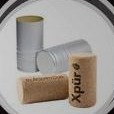
Agglomerated cork is real, traceable, closure-grade cork, ground into granules, sorted for density and size, treated, mixed, and unit molded. All of ours are made by Amorim, with no plastic fillers.
Three Kinds of Cork Stopper
| Type | How it's made | Our corks |
|---|---|---|
| Natural | Carved from a single piece of cork bark | Naturity natural corks, NDtech, and Acquamark (natural cork with a water-based coating) |
| Agglomerated with natural discs (technical) | An agglomerated cork body with a disc of natural cork on each end | Twin Top and Twin Top EVO |
| Micro-agglomerated | Fine cork granules, 1 to 2 mm, bonded and molded into one uniform stopper | Neutrocork and Xpür, Qork, and Spark One Xpür for sparkling wine |
"Technical cork" and "composite cork" are names you'll hear for the agglomerated types. They all start as cork granules.
Agglomerated vs. Micro-Agglomerated
The difference is the size of the granule. A micro-agglomerate is made from very fine granules, which gives a denser, more uniform stopper from one cork to the next. That consistency is why micro-agglomerates have all but replaced synthetics for value-minded wines. A Twin Top uses an agglomerated body and puts natural cork discs on the ends, so the wine meets a natural cork disc. The Twin Top EVO steps up to an individually moulded micro-agglomerate body with high-grade natural discs.
What Holds It Together?
A binder. Amorim's micro-agglomerates bond the granules with an extensively researched, food-grade binder. Qork goes a step further: at least 80% natural cork granules in a binder made with 100% vegetable polyols from wine grape seed oil.
No plastic filler. Look closely at the cheapest micro-agglomerated corks on the market. To lower the cost of production, some blend plastic fillers in with the cork granules and the binder. That plastic is just plain not good for the wine. None of our corks use plastic fillers. Xpür, for example, is 98% cork by volume.
What About TCA?
Grinding bark into granules is what makes deep cleaning possible. Amorim treats the granules before they're ever a cork: ROSA treatment for Neutrocork and Twin Top, and Xpür supercritical CO2 for Xpür, Qork and Spark One Xpür. Xpür removes volatile compounds in general, including TCA, for non-detectable TCA performance: releasable TCA at or below 0.3 ng/L. Twin Tops have set Amorim's records for the lowest occurrence of detectable TCA over the broadest sample, and they're sampled for TCA nine times between bark and bottle.
How Long Will It Age?
Match the cork to the time in the bottle. As a conservative guide: Neutrocork for about 3 years, Xpür 44 mm and Twin Top for about 5, Xpür 49 mm for 7 to 10, and Twin Top EVO in between. Past that, you want a one-piece natural cork like NDtech. The full picture, with oxygen numbers from Amorim's tech sheets and a screw cap comparison, is in our cork aging guide.
Agglomerated Cork Questions
Is agglomerated cork real cork?
Yes. It's real, traceable, closure-grade cork, ground into granules, sorted for density and size, treated, mixed, and unit molded. Ours are made by Amorim, with no plastic fillers.
What's the difference between agglomerated and micro-agglomerated cork?
Granule size. Micro-agglomerated cork uses fine granules, 1 to 2 mm, for a denser, more uniform stopper. Neutrocork, Xpür and Qork are micro-agglomerates. Twin Top has an agglomerated body with natural cork discs on each end.
Is composite cork the same as agglomerated cork?
It's another name for the same idea: cork granules bonded together. Ask what's in the binder and whether there's a plastic filler.
Do your agglomerated corks contain plastic?
No plastic filler. None of our corks use plastic fillers.
Can agglomerated cork cause cork taint (TCA)?
The granules are treated before they're molded. Xpür, Qork and Spark One Xpür are treated with supercritical CO2 for non-detectable TCA, releasable TCA at or below 0.3 ng/L. Neutrocork and Twin Top get Amorim's ROSA treatment.
How long can I age wine under an agglomerated cork?
From about 3 years for Neutrocork to 7 to 10 years for Xpür 49 mm (ENOTOOLS field guidance). See the cork aging guide.
Will it run on my corker?
Yes. Micro-agglomerates run like any other cork on your line, and Twin Tops run on the same bottling lines as natural corks. Our corking checklist covers storage, headspace and insertion.
Can I try them before I buy?
Yes. Untreated samples come with a quote, or we'll send treated, ready-for-bottling samples, printed or unprinted, for a trial side by side with the cork you use now. Request a trial or ask for a quote.