Selection and Storage of Corks
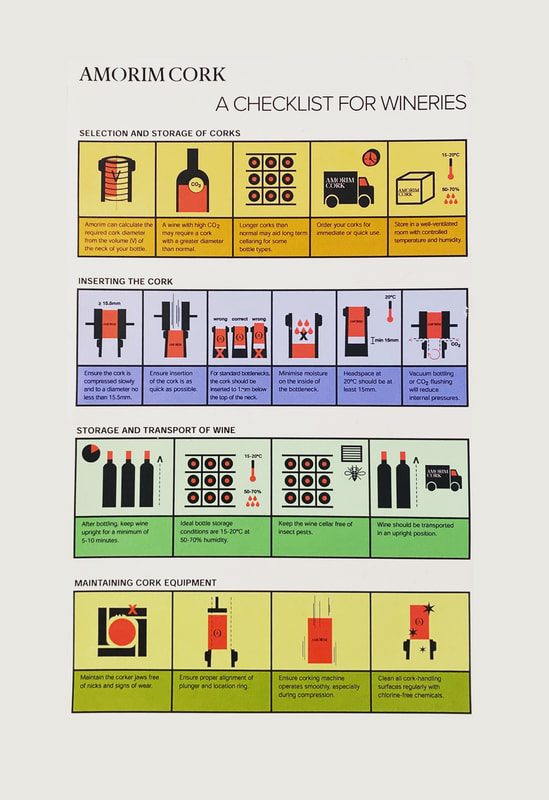
- Amorim can calculate the required cork diameter from the volume of your bottle's neck.
- A wine with high CO2 may need a cork with a larger diameter than normal.
- Longer corks than normal may help long-term cellaring for some bottle types.
- Order corks for immediate or quick use.
- Store corks in a well-ventilated room at a controlled 15–20 °C (59–68 °F) and 50–70% humidity.
Inserting the Cork
- Compress the cork slowly, to a diameter no less than 15.5 mm.
- Insert as quickly as possible.
- For standard bottlenecks, insert the cork to about 1 mm below the top of the neck.
- Minimize moisture on the inside of the bottleneck.
- Headspace at 20 °C (68 °F) should be at least 15 mm.
- Vacuum bottling or CO2 flushing reduces internal pressure.
Storage and Transport of Wine
- After bottling, keep wine upright for at least 5–10 minutes.
- Ideal bottle storage is 15–20 °C (59–68 °F) at 50–70% humidity.
- Keep the cellar free of insect pests.
- Transport wine upright.
Maintaining Corking Equipment
- Keep the corker jaws free of nicks and signs of wear.
- Check the alignment of the plunger and the locating ring.
- Make sure the corker runs smoothly, especially during compression.
- Clean all cork-handling surfaces regularly with chlorine-free chemicals.