
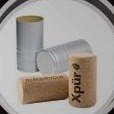
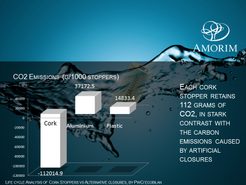
The life cycle analysis of the three main wine stopper types is sure to increase your interest in the venerable cork. For the basics in brochure form, read this.
Cork Is Culture
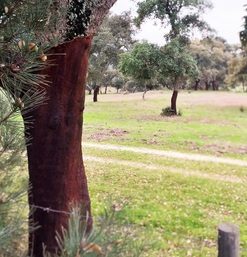
Cork is the bark of a highly adapted species of oak found mainly in the forests of Portugal and neighboring countries. Some speculate that the ancient oak able to regenerate its skin after wildfires was the fittest to survive. Cork forests are protected by law and grown only organically. High demand for the bark drives active stewardship and preservation of the trees: local reverence for ecology, fueled by the economy.
The trees volunteer their bark to willing recipients, who relieve the tree of the portion it can spare so it can live to be shaved again in nine years. Cork forests are a significant part of our planet's ecology: they provide habitat and remove greenhouse gases. The cork industry is a tradition and of utmost economic importance to Portugal, and the specialists who harvest it are among the most highly paid agricultural workers in the world.
Ecology
Regular stripping enhances the cork oak's ability to absorb carbon dioxide: a stripped tree absorbs five times more CO2 while it replaces its bark. Cork oak forests are estimated to retain up to 14 million tons of CO2 a year, offsetting roughly 4.2% of global fossil fuel emissions.
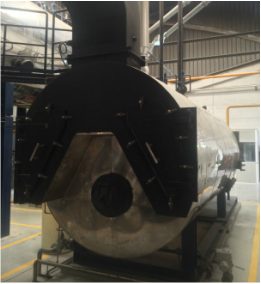
Wineries that consider the environment generally use natural cork. It's natural, renewable, sustainable and recyclable, and cork manufacturing is among the greenest industries. Amorim, the world's largest cork maker, generates 65% of its electricity in-house by converting forest and factory waste to power.
Some History
Since Dom Pérignon started using cork in the 1600s, the tradition of cork as a wine stopper has been strong. Natural cork was largely uncontested as a closure for 300 years. And then people started talking about TCA.
What Is TCA?
The taint typically associated with corks is TCA (2,4,6-trichloroanisole). It's offensive to the nose and can spoil a wine, but it's harmless. TCA is a randomly occurring, systemic condition within the cork oak itself, and it can find its way into wine several ways, most commonly associated with a TCA-riddled cork.
Between 1999 and 2008, non-cork closures grew in popularity over TCA concerns. That was a little unfair to cork. It turned out that barrels, boxes, shipping containers, floor drains, wooden beams, humidifiers, and anywhere else dirt, natural wood fiber, moisture and chlorine had met could harbor TCA.
TCA seemingly peaked around 1999. Cork was demonized and the witch hunt began, with dubious contamination rates as high as 12% popular to repeat. The real issue is two-fold. A beginner will shout "TCA!" over what might be Brett, VA or some other issue, while a trained nose can identify it and professionals can spot it below most people's threshold. And TCA can dull the fruit in the nose, or cause bottle variation, before the average nose can smell it.
How Can TCA Be Natural If It Requires Chlorine?
One theory is lightning: near sea water, it could cleave chlorine away from a salt molecule. It's a theory. Consider a swimming pool converted to salt: it still has chlorine in it.
Lose the Bleach
Chlorine is a key component of TCA, and all but the maverick or uninformed have since barred it from the winery. Breweries barred it for the same reason, and they don't use corks!
One Bad Apple
While the cork world scrambled in the early 2000s, throwing capital at R&D, quality control, and bark harvest and handling reform, new numbers put the real rate around 7%. That was "too high," and the screw cap and its ugly sister the plastic plug were on everyone's mind. It was just a wild coincidence that sales of peroxide and ozone went up dramatically. Or was it? Suddenly winemakers admitted TCA was linked to winery sanitation, while still blaming corks. Most significantly, the universal fear of TCA led to an industry-wide reevaluation of sanitation. You could argue those dark days led to higher quality wines, and better quality control for cooperages that now carry TCA-free certification.
The Educated Consumer
Consumers are why any of us have a job in this industry, and wine has a charm unrivaled by most beverages. Wine lovers pore over anything that makes them more knowledgeable. Nobody wants to buy a bottle and find it spoiled, tainted or oxidized, so the fear of TCA found fertile soil.
By the early 2000s, it became very cool to be the first to proudly condemn a wine as "corked" at a party or conference. Since the average consumer can't identify TCA, "corked" was overused, often for any wine that was "off." A bottle isn't corked unless the wine was ruined by a cork riddled with absorbable TCA. The telltale smell: diminished fruit with an overbearing odor of wet cardboard, old basement or rotten burlap. It's unmistakable when found.
Average noses can find TCA in the bottle at about 4 parts per trillion; expert noses at 2 or even 1 ppt. And wine quality actually suffers at levels as low as 2 ppt, making it seem poorly grown or made, often before a good smeller can blame TCA.
When I hear outdated and inflated figures, I ask for the source and never get one. If you hear "less than one half of one percent of commercial-grade corks from the top producers still have absorbable TCA," you might be talking to someone who knows. And you are.
Reformation
Since the migration toward alternative closures, the cork industry has taken quality control and R&D to new levels. Prevention, controls and corrections have made this a different world for the venerable cork. Are we under 1% in commercial wines now? In my experience, yes. In a competition I judged in February 2013, one of the 135 wines I tried had TCA. It wasn't a customer of ours. Today Amorim's NDtech corks are individually tested, and Naturity and Xpür treatments deliver non-detectable TCA.
The Life of the Wine
Long-term storage of quality wine demands a natural cork seal. Synthetic stoppers allow the most oxygen in and the highest loss of SO2 over the wine's life. As a winemaker, consider that alone as a reason to look at Neutrocork as a lower-cost, better-sealing alternative to synthetics.
Screw caps allow the least of each, but they completely arrest the wine's development in the bottle and contribute nothing positive as it ages. The micro-oxygenation and contact with that 24 mm wide piece of cork oak can actually flatter wines designed for aging, and consumers are flattered that the winery thought enough of them to invest in the closure.
Under one type of screw cap, reduction (the opposite of oxidation) becomes the issue, which demands a change in winemaking style. The lack of sulfur dissipation can create an offensive nose for the sulfur-sensitive and force aggressive decanting. If you use screw caps, trust the closure and act accordingly to prevent reduction: lose the fear of spoilage and stop putting SO2 so high at bottling. Keeping free SO2 high enough for ten years under cork in a screw cap wine is as logical as wearing a parachute in a boat.
Be careful in your research before committing to screw caps. Your screw cap wine has to be transported and stored carefully so as not to compromise the seal. Ever wondered how many cases stacked on top it takes to ruin the threads on the bottom case? Compare that to cork-sealed wines recovered intact from shipwrecks.
More Points Against the Screw Cap
Say it with me: carbon footprint. Every ton of aluminum made creates four tons of carbon. Also, look up "red mud."
The Cockroach Theory
When there's one, there will be more. Some big names have made very public moves back to Mother Nature. In 2012, Barossa Valley's Rusden Wines returned to cork after a five-year screw cap trial that revealed persistent quality problems: overly reductive wines and bottle variation that didn't happen under cork. Amorim reported wineries and major UK retailers returning to cork in several key markets, citing consumer preference, big improvements in cork quality, the limits of alternative closures, and cork's environmental advantages.
In Their Words
- "We decided to change to the natural cork stopper. It is a great sealant and the fact that it is a natural product is one of the main reasons we came back to cork." Steve Rued, Rutherford Wine Company, USA
- "Our wines really are better with cork. They may not be perfect, but simply taste better." Duncan Savage, Cape Point Vineyards, South Africa
- "We have gone back to using cork stoppers in quality wines. In the ten years during which we used screw caps, the quality of cork available has dramatically improved." Tony Bish, Sacred Hill, New Zealand
I'm Not Tilting at Windmills
Cork is still the number one closure: 94% of American consumers surveyed prefer cork in wine (Nielsen). Can you afford to gamble on low-buck packaging? Isn't it hard enough to get people to buy wine from somewhere besides California? Unless the wine costs under $9, regular wine drinkers expect a cork. And even for low-priced wine, we sell something that looks like 100% natural cork for less than a plastic plug costs.
I Think I've Made My Point
Scientific and industrial advances have dramatically reduced the risks of natural cork, while proving it's still the most environmentally sound closure. If you respect tradition enough to use a bottle, please use a closure made from cork. Your wine, your customers, the 2.1 million hectares of cork forest, Mother Earth, ENOTOOLS and Amorim will thank you!
Joe Lutomske
Chief Blatherer, ENOTOOLS.COM