
ENOTOOLS10 to save 10%.Jump to: At Harvest · Pre-Fermentation & Fermentation · Malolactic & Maturation · Just Before Bottling · Between Wines · Spirits & Beer · Try Before You Buy
Pick the job first: protect (VBX, Anti-Ox), structure (EBX 810, #10), or build flavor (Primary Colors, La Recette, oak). Protect early. A late addition can only mop up what's left. Dosages below come from Amedee's technical sheets; always confirm with a bench trial and your enologist.
At Harvest
Add protection tannins as early as possible, on the grapes or the must, before oxidation starts. Shop harvest products
VBX: Vinification Tannin
Extraction, color fixing and protection for challenging harvests.
A blend of hydrolysable and condensed tannins (French oak, gall nut, tara and grape seed) with a light toast. It maximizes extraction of pigments and aromas, fixes and protects color, adds structure, helps protein stability, and inhibits Botrytis and the oxidative enzyme laccase, which SO2 can't control. Codex compliant and usable in organic winemaking.
Recommended Dosage
- On harvest: powder 25–120 g/tonne · liquid 120–600 mL/tonne
- In tank: powder 2–20 g/hL · liquid 10–600 mL/hL
- Add as a 3–10% solution to avoid local overdosing. Use the whole powder package at once.
Anti-Ox (EBX-Protect): Protective Tannin
Fast antioxidant protection from harvest to bottling, in any color.
A Codex-compliant complex of oenological tannins that protects against oxidation throughout vinification and aging, with protection that lasts to bottling and beyond. It helps reduce SO2 while keeping freshness, fruit, volume and tension, with a low, integrated structural impact, and it helps prevent "mousy taste." Versions for reds, and for whites and rosés.
Recommended Dosage
- Indicative: 3–4 g/hL (0.25–0.33 lb per 1,000 gal), depending on wine profile
- When: as early as possible (harvest), then alcoholic fermentation, malolactic fermentation and aging
- Powder: dissolve before adding for even distribution. Trials recommended.
Pre-Fermentation & Fermentation
Structure and protection in the same window. Shop pre-fermentation products
EBX 810: Tannin Structure Power
Pure, untoasted French oak tannin to structure, protect and reveal the wine's potential.
A powdered polyphenol concentrate from matured French oak heartwood. It protects from oxidation and reinforces structure, building the wine around a perfect acidity with low bitterness. 100% natural, no preservatives or additives, and usable in organic winemaking. Also used in spirits.
Recommended Dosage
- Reds and sweet whites, during vinification: 10–20 g/hL
- Reds and sweet whites, during aging: 5–15 g/hL
- Whites: 2–10 g/hL
- Premix at 5–10% in the wine (or hot RO water) and let it mature for several hours before adding. Following this procedure significantly affects the results.
Oak Chips in the Fermentor
Add chips directly to the must, one toast or a blend. Oak added during fermentation integrates more and shows less aroma, which is good for wines drunk within the year.
Recommended Dosage
- Contact: 5 days to 1 month during fermentation
- Dose: see the conversion table on the oak page (a new-barrel equivalent is about 350 g/hL on whites, 500 g/hL on reds)
Finishing tannins can also go in during fermentation: see the dosages under Primary Colors.
Malolactic & Maturation
Where the wood and the oxygen do their work together. Shop maturation products
Primary Colors: Finishing Tannins
Nine single profiles, one oak and one toast each. Use one, or blend them like a palette.
Extracted at low temperature in reverse-osmosis water to reproduce what a barrel gives, no more and no less, for complexity without astringency or bitterness. They stabilize color, protect against oxidation and refine the profile. No additives or preservatives; usable in organic winemaking. The first digit is the oak (1 = French, 2 = American), and the number rises with toast intensity.
| Profile | Oak | What it does |
|---|---|---|
| #10 Structure | French, untoasted | Freshness on the attack, mid-palate structure |
| #12 Fruity | French | Reveals the fruit, variety and terroir |
| #13 Vanilla | French | Roundness and volume through the mid-palate and finish |
| #14 Spicy | French | Elegance, spice and vanilla; helps control pyrazines |
| #15 Furfural | French | Toasted almond, caramel, toasted bread |
| #15s Smoky | French | Smoky depth (never on smoke-affected fruit) |
| #22 Toffee | American | Creamy caramel, toffee, sweet spice |
| #23 Caramel | American | Caramel, vanilla, gentle sweetness |
| #24 Black Coffee | American | Roasted coffee, bitter chocolate, a touch of smoke |
Recommended Dosage
- Powder (indicative): whites 0.1–0.5 g/hL · reds 1–4 g/hL (0.08–0.33 lb per 1,000 gal)
- Liquid, reds and sweet wines: alcoholic fermentation 20–40 mL/hL · malolactic 20–40 mL/hL · aging 5–25 mL/hL
- Liquid, whites: one-third of the red dose. White color is affected from about 3 mL/hL.
- Correcting oxidation: #10 (or #12) at higher doses, 4–10 g/hL
- Liquid is 200 g of tannin per liter: 1 L of liquid equals 200 g of powder.
La Recette: Ready-Made Blends
Five pre-set profiles developed with Amedee's partner enologists, for a style target in one step.
Several toasts, sometimes both oaks, composed at the wood stage to copy a barrel's toast gradient. Also available as 18 mm staves.
Recommended Dosage by Blend
- Minerality (fresh whites: crispness, citrus, length): 0.1–0.4 g/hL · 0.5–2 mL/hL
- Roundness (structured whites: richness, length): 0.4–0.8 g/hL · 2–4 mL/hL (above 3 mL/hL affects color)
- Fruitissimo (light reds: red fruit, mid-palate, sweetness): 1–3 g/hL · 5–15 mL/hL
- Lightness (reds: floral notes, freshness, length): 2–4 g/hL · 10–20 mL/hL
- Amplitude (concentrated reds: volume, spice, black fruit): 3–5 g/hL · 15–25 mL/hL
Staves: 7 mm & 18 mm
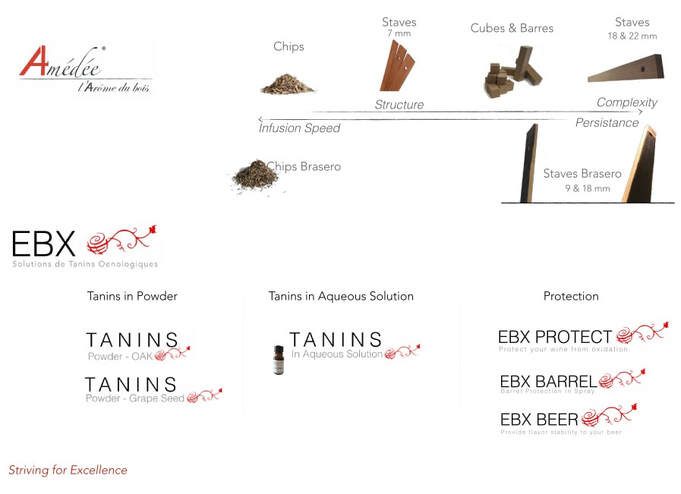
French oak air-dried 36 months. 7 mm is a finishing tool; 18 mm is an aging tool that brings its own oxygen and behaves like a barrel. Keep them submerged with stainless leaches.
Recommended Dosage
- 7 mm: 0.5–3.0 staves/hL · standard infusion 4 months
- 18 mm: 0.2–1.2 staves/hL · standard infusion 7 months
- New-barrel equivalent: about 1.8 (7 mm) or 0.7 (18 mm) per hL on whites; 2.8 or 1.1 on reds. Shorten the time, raise the dose.
Oak Chips: Chips Petite & Élégance
Chips Petite in the Primary Colors profiles and untoasted, and Élégance large 2 cm chips from low-tannin French oak for a discreet oak that doesn't mask the fruit.
Recommended Dosage
- Range: whites and rosés 100–300 g/hL · reds 150–500 g/hL (new-barrel equivalent about 350 g/hL on whites, 500 g/hL on reds)
- Contact: 5 days to 1 month during fermentation · 1–2 months during MLF or aging (Élégance 1–3 months) · 5–7 days for untoasted during aging
Barrel Inserts: 22 mm Sticks
Give a sound but spent barrel back its oak, while it keeps breathing naturally. A barrel releases around 60% of its oak in a year: after one year about 40% is left, after two about 16%.
Recommended Dosage
- One kit per barrel: 8 sticks equals a new barrel; 4 sticks equals a one-wine barrel
- Contact: 6–12 months
EBX 810 (aging dose above) and Anti-Ox are also used during maturation.
Just Before Bottling
Finishing tannins can go in a few days before bottling after a trial of at least 15 days. Homogenize the tank before bottling, and ask about direct injection into the bottle. Keep the sequence that protects your stability tests: fining, then tannin, integration, cold stabilization, tests, and filtration last. Use Anti-Ox at every oxygen pick-up: racking, filtration and bottling. Shop bottling products
Between Wines: Barrel Care
EBX Barrel Protect
A natural tannin spray that protects empty barrels against Brett and spoilage for up to about three months, with no sulfur, ozone or UV. Full details
Recommended Dosage
- 35 mL per barrel, sprayed into a clean, freshly scalded barrel while it's still hot; let it rest at least 1 hour, then bung and store
- Batches treat 30 or 150 barrels (225 L). Calibrate the gun: 5 bar, 35 mL in 7 seconds.
Spirits & Beer
- EBX #410 Spirit Enhancer: liquid Limousin oak for spirits, with full integration in 3–6 months.
- VBX Beer Protect: protects beer against oxidation, staling and skunky flavor (10 mL/hL in the whirlpool).
Try Before You Buy: AMEDEE Lab
Free tools built with Amedee's partner enologists, no account needed. They give proposals to argue with, not verdicts.
Drop-By-Drop Trial
One glass trial turned into a dose in every format, with integration times. Start here.
Oak Dosage Simulator
Your volume, wine and target in; dose, format and contact time out.
Barrel Diagnostic
What your used barrels still give, and how many insert sticks to add.
Decision Making Kits
10 mL bottles of 5 or 9 Primary Colors, or La Recette, to trial on your own wine.
Oak Conversion Table
Chips to staves to tannin equivalents, with contact times.
How to Dilute Tannins
Powder tannins clump if you rush them.
Dissolving Powder Tannin Without Lumps
- Weigh, don't estimate. At these doses a 20% error is tasted.
- Dilute, never pour dry. Sprinkle the tannin onto about 10 times its weight of warm water (not boiling), stirring.
- Let it hydrate 10–30 minutes, then stir again until clear.
- Add in a steady stream during a pump-over or stirring, so it sees the whole tank. Use within 3 hours.
- Don't stack treatments: no protein fining, bentonite or tight filtration in the days that follow.
Questions & Answers
What is an oenological tannin, and what is it actually for?
It is the extractable fraction of oak, chestnut, gall nut or grape seed that a wine would pick up slowly on its own, delivered in a form you can measure out. Under the Codex Oenologique it is an authorized additive for structure, stabilization, protection and clarification, not a flavoring. In the cellar you reach for one to protect juice from oxygen and enzymes, to structure a wine that is short or losing color, or to build and enhance flavors the wine already has. Decide which of the three you need before choosing a product.
French oak or American oak: what really changes?
Aroma and tannin move in opposite directions. American oak carries far more whisky lactone, giving coconut, dill and sweet vanilla, while French oak is subtler, leaning toward spice and toast. French oak, however, is much richer in ellagitannins, the fraction that handles structure and oxygen. So pick the species for the aroma you want, then check that the wine still gets the structure it needs; switching from French to American oak often costs ellagitannin without anyone noticing. An untoasted tannin such as #10 or EBX 810 can add that structure back without changing the aroma.
How does La Recette differ from the Primary Colors range?
Primary Colors are single profiles: one oak, one toast level, one clear signature, numbered in order of toast intensity (#10 to #15s on French oak, #22 to #24 on American). La Recette blends are pre-composed from several toast levels, sometimes both oaks, to mimic the toast gradient a real barrel has in the thin layer the wine touches. Use a single Primary Colors profile to fix one specific gap cheaply and precisely; use La Recette when you want a complete barrel-like oak signature.
Which tannin best mimics barrel aging?
First ask which barrel you are copying: a new barrel gives up roughly 60% of its oak in the first year, so new, second-fill and third-fill barrels are very different tools. A barrel supplies wood tannin, toast flavor, slow oxygen and time. A tannin covers the first two, but not the oxygen. If you can add oxygen through micro-oxygenation, a tannin reaches a similar result much sooner; if you cannot, La Recette in 18 mm staves brings oxygen inside the wood. Include an untoasted component (#10) too, since a barrel's heads are untoasted.
Reds, rosés and whites: how does the approach change?
Start from the goal rather than the color: protection (VBX at crush, Anti-Ox at any stage), structure (EBX 810 before fermentation, #10 during maturation) or flavor complexity (Primary Colors and La Recette). On whites and rosés, color sets the limit: an addition starts to show in a finished white at about 0.5 g/hL, so stay under it, and on rosé judge the shade against your target. For whites, add protection on the juice before oxidation starts. Reds have no color ceiling of that kind, and tannin actually supports their color.
How long before I can taste the effect of an addition?
The effects arrive on three different clocks. Aroma and flavor show within hours to about two days. Integration, when the oak stops sitting on top of the wine, takes about two weeks, and perceived oak intensity drops sharply over that period, so the day-14 reading is the one to trust. Structure, texture and color stability take months. Never judge on the day of the addition or you will overdose. With chips, remember the wine keeps taking up oak for about two weeks after the wood comes out.
How do I compare two tannins fairly?
Compare them at equal sensory effect, not equal weight, because products differ widely in reactive content. Draw an untreated control and the trials from the same tank at the same time, seal them with minimal headspace so all get the same oxygen, and store the whole set together beside the tank. Taste at day 14, blind and in random order, since a product that wins on day one often loses by then. Beyond aroma, look at the finish, any drying, and where the color went; limit the number of samples per sitting.
How do I dissolve and add a powder tannin without lumps?
Powder tannins absorb moisture and clump easily, so dissolve them in warm (not boiling) water rather than wine, sprinkling the powder onto the water instead of pouring water onto the powder. Let it stand for ten to fifteen minutes, stirring now and then, until no grains remain. Add the solution during a pump-over, racking or transfer so it spreads through the whole volume, never onto a still tank. For bench trials, make a stock solution and dose it by volume. Liquid tannins avoid all of this.
What is the shelf life once opened, and how should I store them?
Oxygen, heat and light degrade tannins, in that order. Keep unopened packs cool, dry, dark and sealed, away from temperature swings that cause condensation inside the packaging. Once opened, reseal immediately, avoid decanting into other containers, and use the pack within the current season rather than carrying it into the next vintage. A tannin can lose effectiveness without looking any different, so if an opened pack has sat a while, run a quick bench trial before dosing it. The pack and technical sheet give the exact best-before date.
Can I use your tannins in organic winemaking, and are they vegan and allergen free?
Organic acceptance depends on your certifier and scheme (EU organic, USDA NOP, Demeter and others draw the line differently), so confirm the specific product with them; oak and chestnut tannins are widely accepted, and Amedee will supply statements and certificates on request. The products are plant extracts made with water and no solvent, with no animal-derived material and no gluten-containing grain in the raw materials. For any label claim, get the written specification of the exact product. Codex-compliant products are the ones meant for wine; those marked "not Codex" are for other beverages.
Can tannins help on smoke-impacted fruit?
A tannin will not remove smoke taint; the smoke compounds remain. What it can do is soften the ashy, drying finish by rebuilding mid-palate volume. Avoid astringent tannins such as grape seed, which make that finish worse. A sensible approach is VBX at crush and a short maceration, then La Recette at finishing (Amplitude or Fruitissimo on reds, Rondeur on whites), and never #15s Smoky. Taste trials after swallowing, and re-taste weeks later, because bound smoke compounds keep releasing over time.
How much SO2 can a tannin save?
There is no conversion between tannin and SO2, because they work on different reactions. A tannin spares SO2 by absorbing oxygen first, and it inhibits laccase on botrytised fruit, which SO2 cannot control at practical levels. The biggest savings come from skipping SO2 where it does little: in the must before fermentation, on high pH wines, and from sulfur wicks in barrels (Barrel Protect adds none). Expect to hold SO2 steady rather than eliminate it; tannin has no antimicrobial effect against Brett or bacteria.
Adapted from US Amedee’s Questions & Answers, where you can search every answer in full.
Questions & Answers
How do I try your products before committing to a volume?
Start small, on your own wine. Decision making kits contain 10 ml bottles of several profiles (5 La Recette, 5 Primary Colors, or 9 Primary Colors), enough for a proper bench trial across the range. The online drop test tool then converts your glass trial into a dose in whichever format you use, with integration time for each. Draw the control and trials from the same tank, seal with minimal headspace, store them beside the tank and taste at 14 days, blind and in random order.
Which tool should I use: barrel, tank or drop test?
Pick the one that matches your question. The barrel tool estimates what your barrels still deliver, by age and share of volume, and what to add on top; use it before buying new barrels. The tank tool takes aging time, alcohol, temperature, pH, SO2 and volume and suggests wood, tannin, SO2 and micro-oxygenation settings for an élevage in tank. The drop test converts one glass trial into a dose for every format. All three offer starting points to refine with your own trials and oenologist.
Adapted from US Amedee’s Questions & Answers, where you can search every answer in full.