

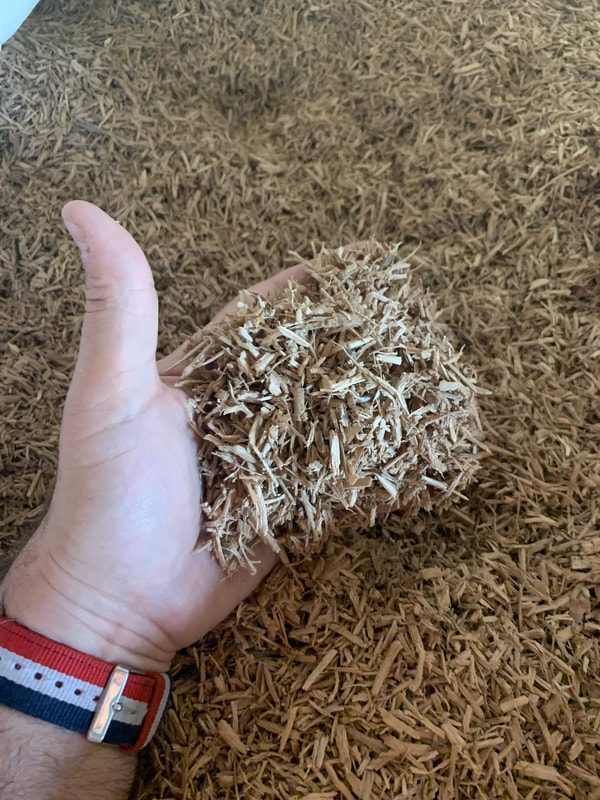
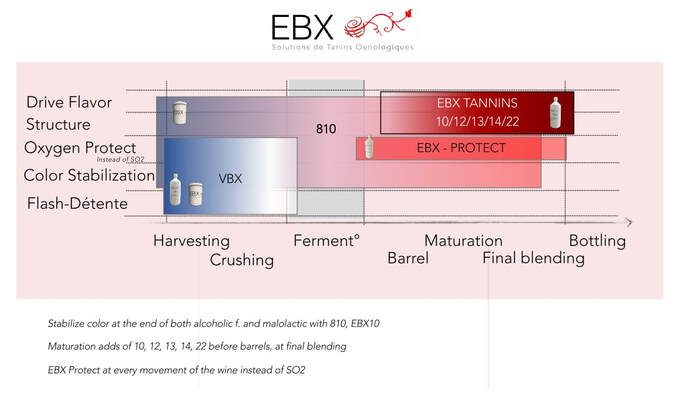
ENOTOOLS10 saves 10%.All EBX oak is French oak air-dried outdoors for 36 months, then convection toasted for precise, repeatable profiles. The chips, staves and inserts come in the same Primary Colors profiles as the tannins: #10 Structure (untoasted) through #24 Black Coffee.
Which Format?
| Format | Best for | Contact time |
|---|---|---|
| Fine chips (2–4 mm) | Fast and economical. Bring almost no oxygen, so pair with micro-oxygenation. | 5 days to 1 month during fermentation · 1 to 2 months during MLF or maturation · 5 to 7 days for untoasted during maturation |
| 7 mm staves | Finishing tool | 4 months |
| 18 mm staves | Aging tool that brings its own oxygen. Behaves like a barrel. | 7 months |
| 22 mm barrel inserts | Sound but spent barrels. 4 sticks equal a one-wine barrel; 8 sticks equal a new barrel. | Barrel program |
For staves, don't cut the time short. Stop too early and the extraction is unbalanced: the surface notes come out first and the structure arrives later, so the wine smells of wood without having its backbone.
How Much Oak: The Conversion Table
Per hectoliter, from Amedee's measurements on their own oak. At the same dose, a white tastes oakier than a red.
| Fine chips | 7 mm staves | 18 mm staves | Finishing tannin | Whites | Reds |
|---|---|---|---|---|---|
| 100 g/hL | 0.5 /hL | 0.2 /hL | 1.3 g/hL | Slightly oaky | |
| 200 g/hL | 1.0 /hL | 0.4 /hL | 2.7 g/hL | Oaky | Slightly oaky |
| 300 g/hL | 1.5 /hL | 0.6 /hL | 4.0 g/hL | Intense oak | Oaky |
| 350 g/hL | 1.8 /hL | 0.7 /hL | 4.7 g/hL | New barrel | Oaky |
| 400 g/hL | 2.0 /hL | 0.8 /hL | 5.3 g/hL | Intense oak | |
| 500 g/hL | 2.5 /hL | 1.0 /hL | 6.7 g/hL | New barrel | |
| 600 g/hL | 3.0 /hL | 1.2 /hL | 8.0 g/hL |
1 hL is about 26.4 US gallons. 300 g/hL of chips is about 25 lb per 1,000 gallons. The full table and method are in Amedee's oak conversion table, and the oak dosage simulator does the math for your tank.
Varietal matters too: a Sauvignon Blanc may be happy with 50 g/hL, while a Chardonnay can take up to 350 g/hL. Toast makes the profile; dose makes the intensity. If you don't like the oak character, the dose isn't always what needs to change.
In the Cellar
- Use an infusion bag for chips and a stainless leach for staves, and circulate at least weekly.
- Never reuse wood.
- Oak uptake keeps going after the wood comes out. Aim slightly under your target when you pull it, taste twice a week, and allow 4–6 weeks after removal before judging.
- Record the removal date as carefully as the addition date.
- Still short? Adjust with a finishing tannin, not more wood: the dose is finer and reads faster.
- Oak added during fermentation integrates more and shows less aroma (good for wines drunk within the year). Added after, it extracts more and builds aging potential.
Bringing Used Barrels Back
A new barrel releases about 60% of its oak in its first year. By the fourth fill, it's a container, not an ingredient. Barrel inserts give a sound barrel back a season of usefulness instead of replacing it. They don't reopen pores or fix leaks or Brett. The barrel diagnostic estimates how many sticks your barrels need. Keep empty barrels clean between wines with EBX Barrel Protect.
Questions & Answers
7 mm or 18 mm staves: which thickness do I need?
Thickness sets both the pace of extraction and how much oxygen the wood brings. A 7 mm stave is a finishing tool: it holds little air and releases its oak over roughly four months, suited to a wine that is already structured or a short élevage. An 18 mm stave is an aging tool: it carries a real internal oxygen reserve and releases it gradually over seven months or more, so the oak blends in the way it does in a barrel. If your tanks have no way to add oxygen, choose 18 mm.
Chips, staves or tannins: which one do I need?
Choose by what you want the wood to do. For oak and oxygen together, as in a barrel, use staves or barrel inserts, since thick oak carries its own oxygen reserve. For precise, repeatable, fast work on flavor, structure or protection, use tannins. Chips are quick and inexpensive but need managing: the wine keeps absorbing oak for about two weeks after removal, so pull them before you reach your target, and they bring almost no oxygen, so pair them with micro-oxygenation or the oak tends to fade within a year.
How do I actually hold chips or staves in a tank?
Plan three things before delivery. Containment: put chips in an infusion bag and staves in a stainless leach so they stay in place and come out cleanly. Circulation: pump over or rack at least weekly, because wood sitting still only flavors the wine right around it. Removal: taste twice a week and take chips out before you hit your target, since oak uptake continues for about two weeks. Don't reuse chips or staves between wines; they are largely spent and become a microbial risk.
What is a barrel insert, and when does it beat buying a new barrel?
An insert is a set of 22 mm French oak sticks placed inside a barrel you already own: 8 sticks to bring a spent barrel back to roughly new-barrel oak, or 4 sticks to reinforce a barrel still in use. It makes sense when the barrel is physically sound but chemically exhausted, since a barrel loses roughly 60% of its oak character per year. It does not help a barrel that leaks, is dirty or carries Brett, and it cannot restore the oxygen transfer an old barrel has lost.
I work in concrete, amphora or stainless. How does that change my oak program?
The vessel mainly decides how much oxygen the wine gets on its own. Stainless gives essentially none, so you must supply it through micro-oxygenation or choose a thick stave that brings its own. Concrete gives a little, depending on lining, plus useful temperature stability. Amphora can give surprisingly much, but it varies widely between vessels. Only a barrel supplies wood and oxygen together. A tannin with no oxygen to react with just sits there, which can look like product failure when it is really a vessel mismatch.
What happens to the oak signature after bottling?
It keeps evolving, mostly for the better if the oak work was done early. The oak aroma typically blends into the wine within six to twelve months, as long as it integrated before filtration. Tannin and color keep slowly bonding, so a wine that is slightly firm at bottling often softens into place; dose to your target, not beyond it. After bottling the only oxygen comes from filling and the closure, so the closure is effectively part of your oak program. Finish anything you wanted the oak to do while in tank.
Do bench trials predict what happens in the tank?
With liquid tannins the match is very close, provided the trial samples are stored in the same conditions as the wine and an untreated control from the same tank sits beside them for the two weeks. Chips never match quite as well, and staves cannot be trialed in a bottle at all, because the oxygen the wood brings is missing from the sample. A tannin trial still points a stave program in the right direction. When scaling up, start at the lower end; you can add more but never take it out.
Adapted from US Amedee’s Questions & Answers, where you can search every answer in full.